


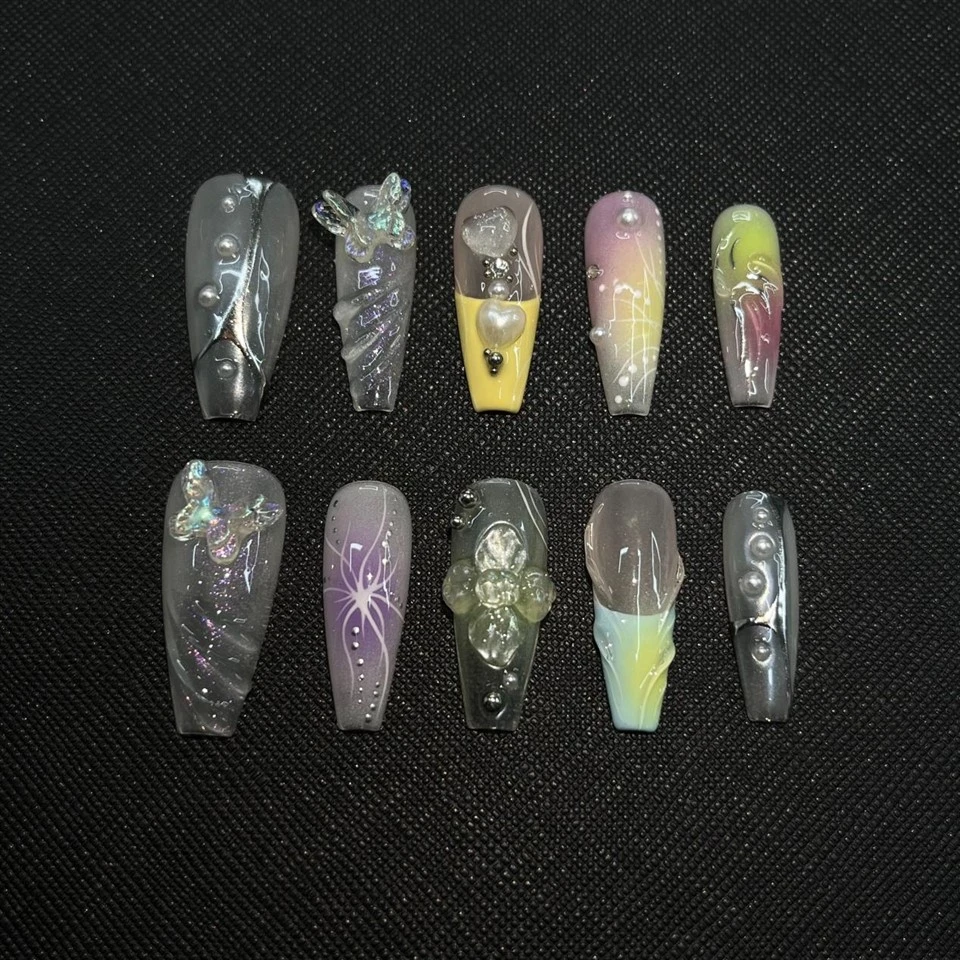
When it comes to creating stunning graffiti nails, one of the most crucial yet often overlooked factors is lighting. As a dedicated graffiti nails supplier, I've witnessed firsthand how the right lighting can transform a simple nail design into a masterpiece. In this blog, I'll delve into the science behind lighting and share insights on what constitutes the best lighting for doing graffiti nails.
The Science of Lighting and Color Perception
Light plays a fundamental role in how we perceive colors. Different light sources emit varying spectra of light, which can significantly impact the appearance of nail polish and the details of a graffiti design. For instance, natural sunlight is considered the gold standard for color accuracy because it contains a full spectrum of visible light. When working on graffiti nails under sunlight, you can see the true colors of the polish and identify any imperfections or color mismatches more easily.
On the other hand, artificial light sources such as incandescent bulbs, fluorescent lights, and LED lights have their own unique spectra. Incandescent bulbs emit a warm, yellowish light that can make colors appear warmer and more saturated. While this can create a cozy atmosphere, it may not accurately represent the true colors of the nail polish. Fluorescent lights, on the other hand, have a cooler, bluish tint that can make colors look dull or washed out. LED lights are becoming increasingly popular due to their energy efficiency and versatility. They come in a variety of color temperatures, from warm white to cool white, allowing you to choose the light that best suits your needs.
Types of Lighting for Graffiti Nails
- Natural Sunlight: As mentioned earlier, natural sunlight is the ideal lighting for doing graffiti nails. It provides a balanced spectrum of light that allows you to see the true colors of the polish and the details of the design. However, relying solely on sunlight can be challenging, especially if you live in an area with limited sunlight or if you need to work on nails at night. If possible, try to position yourself near a window or work outdoors during the day to take advantage of natural light.
- Daylight LED Lights: Daylight LED lights are a great alternative to natural sunlight. They emit a bright, white light that closely mimics the color temperature of natural sunlight, making them ideal for color accuracy. Daylight LED lights are available in a variety of forms, including table lamps, ring lights, and overhead lights. They are energy-efficient, long-lasting, and can be adjusted to different brightness levels to suit your needs.
- Ring Lights: Ring lights are a popular choice among nail artists because they provide even, diffused lighting that eliminates shadows and highlights. They are typically circular in shape and feature a row of LED lights around the perimeter. Ring lights are available in different sizes and colors, and they can be mounted on a stand or attached to a camera for live streaming or photography. When using a ring light for graffiti nails, position it directly in front of you at eye level to ensure that the light is evenly distributed across your nails.
- Table Lamps: Table lamps are a versatile lighting option that can be used for a variety of tasks, including doing graffiti nails. Look for a table lamp with a bright, white light and a flexible arm that allows you to adjust the angle of the light. You can place the table lamp on a desk or table next to you and position it so that the light shines directly on your nails. Some table lamps also come with adjustable brightness settings, which can be useful for creating different lighting effects.
- Overhead Lights: Overhead lights are a good option for providing general illumination in a room. However, they may not be the best choice for doing graffiti nails because they can create shadows and highlights on your nails. If you have overhead lights in your workspace, try to supplement them with additional lighting sources such as a table lamp or a ring light to ensure that your nails are evenly lit.
Considerations When Choosing Lighting for Graffiti Nails
- Color Temperature: Color temperature is measured in Kelvin (K) and refers to the perceived warmth or coolness of a light source. For doing graffiti nails, it's recommended to use a light source with a color temperature between 5000K and 6500K, which is considered "daylight" or "cool white." This color temperature provides a balanced spectrum of light that allows you to see the true colors of the polish and the details of the design.
- Brightness: The brightness of a light source is measured in lumens. When choosing lighting for graffiti nails, look for a light source that provides at least 500 lumens of brightness. This will ensure that your nails are well-lit and that you can see the details of the design clearly.
- Light Distribution: Even light distribution is essential for doing graffiti nails. Look for a light source that provides even, diffused lighting that eliminates shadows and highlights. Ring lights and daylight LED lights are good options for providing even light distribution.
- Adjustability: The ability to adjust the brightness and angle of the light is important for creating the perfect lighting conditions for doing graffiti nails. Look for a light source that allows you to adjust the brightness and angle of the light to suit your needs.
- Portability: If you need to work on nails on the go, portability is an important consideration. Look for a light source that is lightweight and easy to carry, such as a battery-powered ring light or a portable table lamp.
Tips for Using Lighting to Enhance Graffiti Nails
- Position the Light Correctly: The position of the light is crucial for creating the perfect lighting conditions for doing graffiti nails. Position the light source directly in front of you at eye level to ensure that the light is evenly distributed across your nails. Avoid positioning the light source above or behind you, as this can create shadows and highlights on your nails.
- Use Diffusers: Diffusers are a great way to soften the light and eliminate harsh shadows. You can use a diffuser such as a softbox or a diffuser panel to create a more even, diffused light. Diffusers are available in a variety of sizes and shapes, and they can be attached to a light source using a clip or a bracket.
- Experiment with Different Lighting Effects: Different lighting effects can create different moods and styles for your graffiti nails. For instance, you can use a colored gel or a filter to create a colored light effect. You can also use a spotlight or a backlight to create a dramatic effect. Experiment with different lighting effects to find the ones that work best for your style and the design of your nails.
- Take Photos and Videos in Good Lighting: If you plan to take photos or videos of your graffiti nails, it's important to do so in good lighting. Use a daylight LED light or a ring light to ensure that the colors of the polish and the details of the design are accurately represented in the photos and videos. You can also use a reflector or a diffuser to enhance the lighting and create a more professional-looking result.
Conclusion
In conclusion, the right lighting is essential for creating stunning graffiti nails. Whether you're a professional nail artist or a DIY enthusiast, choosing the right lighting can make a significant difference in the quality of your work. By understanding the science of lighting and color perception, and by considering factors such as color temperature, brightness, light distribution, adjustability, and portability, you can choose the best lighting for doing graffiti nails. Remember to position the light correctly, use diffusers, experiment with different lighting effects, and take photos and videos in good lighting to enhance the overall look of your graffiti nails.

As a graffiti nails supplier, we offer a wide range of high-quality graffiti nails, including Geometric Design Nails, Cartoon Graffiti Nails, and Butterfly Painting Nails. Our nails are made from premium materials and are designed to be durable and long-lasting. If you're interested in purchasing our graffiti nails or have any questions about our products, please feel free to contact us for procurement and negotiation.
References
- Fairchild, M. D. (2013). Color Appearance Models. John Wiley & Sons.
- Hunt, R. W. G. (2004). The Reproduction of Colour. Fountain Press.
- Stone, M. C., & Süsstrunk, S. E. (2010). Color Science for Imaging Systems. Wiley-Blackwell.
